
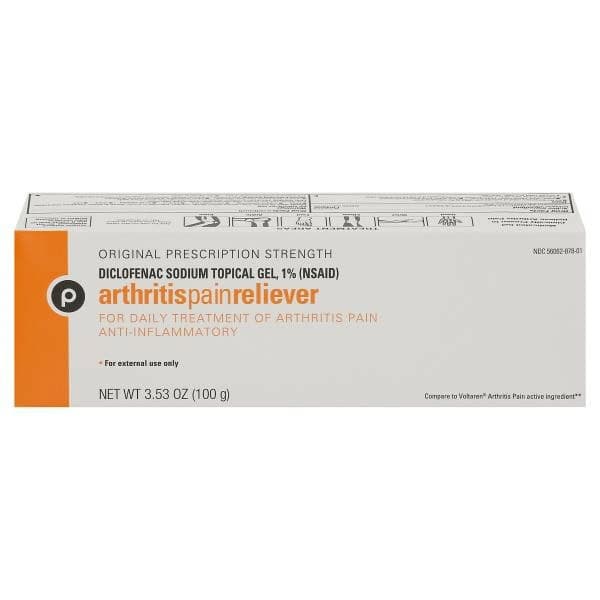
Description
Details
Other Information: Store at 68-77 degrees F (20-25 degrees C). Keep from freezing. Read all product information before using. Keep the dosing card, this carton and accompanying user guide for important information.
Ingredients
Inactive Ingredients Carbomer Homopolymer Type C. Cocoyl Caprylocaprate, Fragrance, Isopropyl Alcohol, Mineral Oil, Polyoxyl 20 Cetostearyl Ether, Propylene Glycol, Purified Water, Strong Ammonia Solution
Directions
Directions
Use up to 21 days unless directed
by your doctor
Not for strains, sprains, bruises or
sports injuries. This product has
not been shown to work for these
types of injuries.
Daily
Per Dose
For your
arthritis pain:
Use 4 times
per day
every day
Do not use
on more
than 2 body
areas at the
same time
Use ENCLOSED
DOSING CARD
to measure
a dose
For each upper
body area
(hand, wrist,
or elbow) –
Squeeze out
2.25 inches
(2 grams),
For each lower
body area
(foot, ankle
or knee) –
Squeeze out
4.5 inches
(4 grams)
Read the enclosed User Guide
for complete instructions:
use only as directed,
do not use more than directed
or for longer than directed,
apply only to clean, dry skin that
does not have any cuts, open
wounds, infections or rashes,
do not apply in same area as
any other product,
do not apply with external heat
such as heating pad,
do not apply a bandage over the
treated area,
store ENCLOSED DOSING CARD
with your Diclofenac Sodium
Topical Gel, 1% product. The
dosing card is re-usable.
Warnings
Warnings
For external use only
Allergy alert: Diclofenac may cause a severe
allergic reaction, especially in people allergic to
aspirin. Symptoms may include:
hives, asthma (wheezing),
skin reddening, blisters,
facial swelling, shock, rash,
If an allergic reaction occurs, stop use and seek
medical help right away.
Liver warning: This product contains diclofenac.
Liver damage may occur if you apply,
more or for a longer time than directed,
when using other drugs containing diclofenac
Stomach bleeding warning: This product contains
an NSAID, which may cause severe stomach
bleeding. The chance is small but higher if you
are age 60 or older,
have had stomach ulcers or bleeding problems,
take a blood thinning (anticoagulant) or steroid drug,
take other drugs containing prescription or
nonprescription NSAIDs (aspirin, ibuprofen,
naproxen, or others),
have 3 or more alcoholic drinks every day while
using this product,
apply more or for longer than directed
Heart attack and stroke warning: NSAIDs, except
aspirin, increase the risk of heart attack, heart
failure, and stroke, These can be fatal. The risk is
higher if you use more than directed or for longer
than directed.
Do not use
if you have ever had an allergic reaction to any
other pain reliever or to a fever reducer,
for strains, sprains, bruises or sports injuries.
This product has not been shown to work for these
types of injuries.
right before or after heart surgery,
on more than 2 body areas at the same time,
in the eyes, nose or mouthAsk a doctor before use if
you have problems or serious
side effects from taking pain
relievers or fever reducers,
stomach bleeding warning
applies to you
you have a history of stomach
problems, such as heartburn,
you have high blood pressure,
heart disease, liver cirrhosis,
kidney disease, asthma, or had
a stroke,
you are taking a diuretic,
you are under age 18 years. It is
not known if this drug works or
is safe in children under age
18 years.
Ask a doctor or pharmacist
before use if you are
under a doctor’s care for any
serious condition,
taking any other drug
When using this product
avoid contact with eyes, nose,
or mouth,
if eye contact occurs, rinse
thoroughly with water
Stop use and ask a doctor if
pain gets worse or lasts more
than 21 days,
redness or swelling is present in
the painful area,
fever occurs,
skin irritation occurs,
any new symptoms appear.
These could be signs of a serious
condition.
you experience any of the
following signs of stomach
bleeding:
feel faint,
have bloody or black stools,
vomit blood,
have stomach pain that does
not get better,
you have symptoms of heart
problems or stroke:
chest pain,
trouble breathing,
leg swelling,
weakness in one part or side
of body,
slurred speech,
If pregnant or breast-feeding,
ask a health professional before
use. It is especially important not to
use diclofenac at 20 weeks or later
in pregnancy unless definitely
directed to do so by a doctor
because it may cause problems in
the unborn child or complications
during delivery.
Keep out of reach of children.
If swallowed, get medical help or
contact a Poison Control Center
right away (1-800-222-1222).